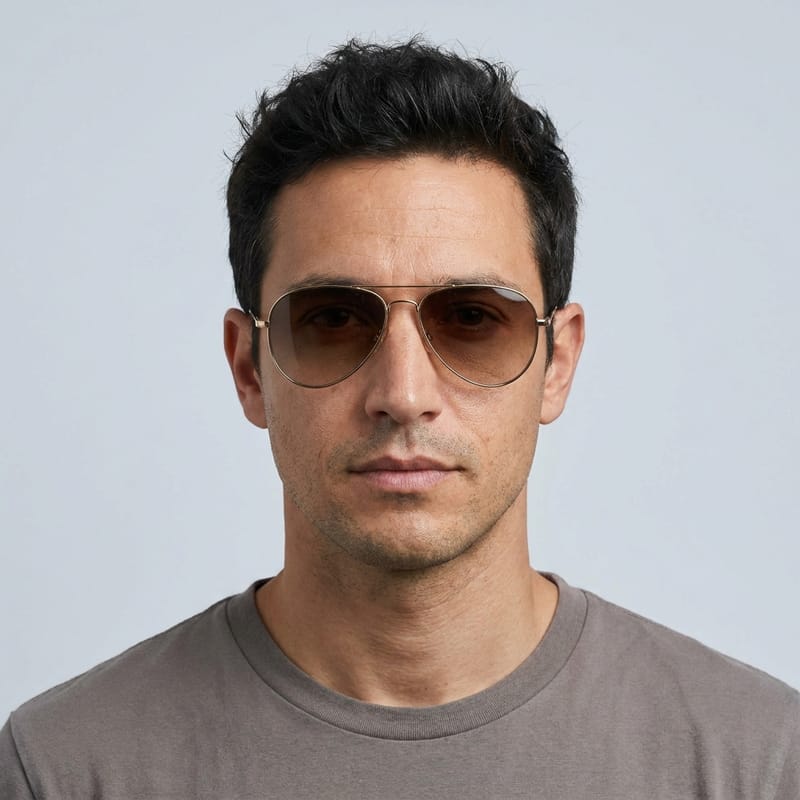
Aviator sunglasses
Teardrop lenses, a double bridge and a thin metal frame. See the pilot classic on your face.
See them on my photoFree first try-on with a free account · right in your browser
- 1
- 2
- 3
Step 1 / 3
Take a front selfie
Look straight into the camera with your whole face in the frame and your hair as you usually wear it. Take off any glasses you have on. Even lighting works best.
Step 2 / 3 · optional
Now a side photo (~45°)
Turn your head slightly to one side for a second photo. The extra angle lets the AI fit the frames to the real width of your face and the line to your ears.
Step 3 / 3
Choose your frames
Pick eyeglasses or sunglasses from the gallery, or upload a photo of any pair you want to try.
- Measuring your face shape…
- Reading your brow line and face width…
- Matching frames to your face…
- Picking your best fit…
Analysis complete
We found your best frames
See yourself in them — front, side and close-up.
The analysis didn't work this time.
Pick your frames
Your photos are processed securely and saved in your private Glasses Suite until you delete them. Never shared, never used for training.
Free account · your first try-on is free
See your result — free
Create a free account to run your try-on and keep every look in your Glasses Suite. Your first one is on us.
We sent a 6-digit code to
We'll email you frame ideas now and then — unsubscribe anytime with one click.
Aviator sunglasses were developed in the 1930s for US military pilots: large teardrop lenses that dip toward the cheeks to cover the whole eye socket, a double bridge and a thin metal frame. Gold frames with green or brown lenses are the classic.
The deep lens covers a lot of the face, so size matters: the frame should be as wide as your face at the temples, and the bottom of the lens should not rest on your cheeks.
FAQ
Are aviators good for small faces?
Yes, in a smaller size: many aviators come in two or three lens widths, such as 55, 58 and 62 mm. Pick the one that matches the width of your face.
Mirrored or plain lenses?
Both protect equally if they are UV400. Mirrored lenses reflect more light and hide your eyes; plain tints let others see them.