Glasses for every face shape
Opticians do not start from a list of fashionable frames. They start from your face: where it is widest, how long it is, and whether its outline is made of curves or corners. Advice usually sorts faces into six shapes, and each one has frames that balance it and frames that make its strongest feature stronger still.
This guide explains the three rules behind those pairings, then goes through the six shapes one by one, each with an example frame from our gallery and a link to the full page for that shape. The last section applies the same thinking to sunglasses.
The three rules: contrast, width and brow line
The first rule is contrast. A frame repeats whatever lines it shares with your face and offsets the ones it does not, so a soft, curved face gains from straight edges and corners, and a face built on angles gains from curves. The same logic covers proportions: a long face looks shorter behind a deep lens, and a face that is wide at the top looks more even in a frame that keeps its weight low.
The second rule is width, and it wins whenever it disagrees with shape. Look for a front that matches the width of your face at the temples, so the hinges sit roughly where the sides of your head begin. Too narrow, and the face spreads out around the frame; too wide, and the frame slides down the nose and makes small features look smaller still. The numbers printed inside the temple tell you how wide a frame is before you try it, and our guide to choosing frames explains how to read them.
The third rule is the brow line. The top rim should run along your eyebrows or just under them and follow their angle: straight brows sit well over a straight top, arched brows over a curved one. A rim that slices across the middle of your brows gives you two competing lines, and one that floats high above them leaves a strip of forehead showing, which makes the frame look perched.
To use any of this, you need your shape. Pull your hair back, stand square to a mirror and compare four measurements: the width of your forehead, of your cheekbones and of your jaw, and the length from hairline to chin. Which width is largest, and how the length compares with it, points to one of the six shapes below. If you would rather not measure, a selfie on our glasses try-on shows your shape at no cost.
Plenty of faces sit between two shapes, such as round with a slightly squarer jaw. Then follow the feature people notice first and treat the rest as detail: if it is the jaw, start with the advice for a square face; if it is the fullness of the cheeks, start with the round one.
Round face: add corners and a horizontal line
On a round face, the distance from hairline to chin comes out close to the distance across the cheeks, and the outline curves all the way around with no clear angle at the jaw. Frames help most when they bring the corners it lacks and lead the eye sideways: a lens noticeably wider than it is deep, a straight top rim, and a front at least as wide as the cheeks. Small circles and deep, rounded lenses work against it.
Our page on glasses for a round face goes through every frame worth trying, from faceted hexagons to browlines, along with the ones to wear with care.

Rectangle glasses
Rectangular glasses show the contrast rule at its plainest: two straight rims and four corners set against a face that has none. Chosen a touch wider than the cheeks, they are the safest first frame to try if your face is round.
Try it on me →Square face: add curves
Trace the sides of a square face and the line barely moves inward from forehead to jaw, which turns at a visible angle under each ear. Here the contrast rule runs the other way: curved lenses, soft corners and a light lower rim keep the jaw from being underlined. Width still counts, because a broad face makes a narrow frame look too small for it.
The page on glasses for a square face covers the round, oval, aviator and cat-eye frames that suit it, and how to soften an angular frame if that is what you love.

Round glasses
Round glasses are the clearest answer to a square jaw, since a circle has no straight line to echo. They stand here for the whole rounded family; in thicker acetate they also hold their own beside strong features, which a fine wire circle may not.
Try it on me →Oval face: let width and features decide
An oval face is the shape the others get compared with: longer than it is broad, with no single area that dominates and an outline that narrows gently toward the chin. Nothing needs balancing, so the choice moves to the other two rules, width and brow line, and to your features. Fine features suit thin metal and slim acetate; a strong nose, brow or jaw can carry a thick rim.
See glasses for an oval face for frames to try and the two kinds of size mistake to avoid.

Geometric glasses
Geometric glasses are the kind of frame an oval face takes on easily while other shapes have to think twice. The flat top facet doubles as a straight brow line, so check that it runs along your eyebrows. If you want a frame with some character, start here.
Try it on me →Heart-shaped face: keep the top light
A heart-shaped face carries its width up top: the brow and temples are the broadest part, and the face narrows below the cheekbones to a small, sometimes pointed chin. The aim is to move visual weight down. Look for a thin or clear top rim, no decoration at the brow, and a lens at least as wide at the bottom as at the top, with the front about as wide as the forehead and no wider.
The heart-shaped face page lists the frames that do this best and explains which cat-eye wings to approach with care.

Aviator glasses
Aviator glasses handle both halves of the heart-shaped problem at once, which few frames do. Look at where the lens is widest: below the eyes, not at the brow.
Try it on me →Oblong face: add depth and width
An oblong face is long and fairly narrow: its length clearly exceeds its width, and its sides run almost parallel from temple to jaw. Frames shorten it in two ways, by covering more of it from top to bottom and by drawing lines across it. That means taller lenses, a visible top bar, and temples that are thick or in a contrasting color. Small, shallow frames leave more length on show above and below the lens.
The oblong face page compares the deep frames worth trying, from oversized pairs to bold square glasses.

Oversized glasses
Oversized glasses take the depth rule as far as it goes: the lens reaches from the brow toward the top of the cheeks, so there is simply less face left to look long. Keep the temples running straight back, and the size reads as a choice.
Try it on me →Diamond face: build up the brow
On a diamond face, the cheekbones reach out past both the forehead above them and the jaw below, and the chin comes to a defined point. The frame has to widen the top of the face to meet the cheekbones: weight or lift along the upper rim, a light or rimless lower edge, and a front at least as wide as the cheekbones, so it does not stop short of them.
The diamond face page walks through the browline, cat-eye, oval and rimless frames that work for this shape.

Browline glasses
Browline glasses follow this advice most literally: the heavy bar sits exactly where a diamond face needs width, and the thin wire below leaves the cheekbones alone. Few frames widen the forehead this much without making the glasses themselves look big.
Try it on me →Which sunglasses suit each face shape
Sunglasses follow the same three rules, with two differences. They are usually larger and deeper than eyeglasses, so they cover more of the face and often the eyebrows too, which relaxes the brow-line rule and makes width count for more. And they have a job to do: a lens that leaves gaps at the sides or below lets glare in, so settle the coverage before the shape, with lenses labeled UV400 or 100% UV protection.
Shape by shape: a round face looks sharper in square sunglasses or rectangular ones; a square face softens behind round lenses, aviators or a rounded cat-eye; a heart-shaped face suits aviator sunglasses and thin metal rounds; an oblong face looks shorter in oversized sunglasses or deep squares; a diamond face gains width at the brow from cat-eye sunglasses; and an oval face can wear almost any of them, sport wraparounds included.
The frame we pick as your best fit is always an eyeglass frame, because clear lenses show how it sits on your eyes and brows. Every pair of sunglasses in the gallery is still there for you to try on your own photo.
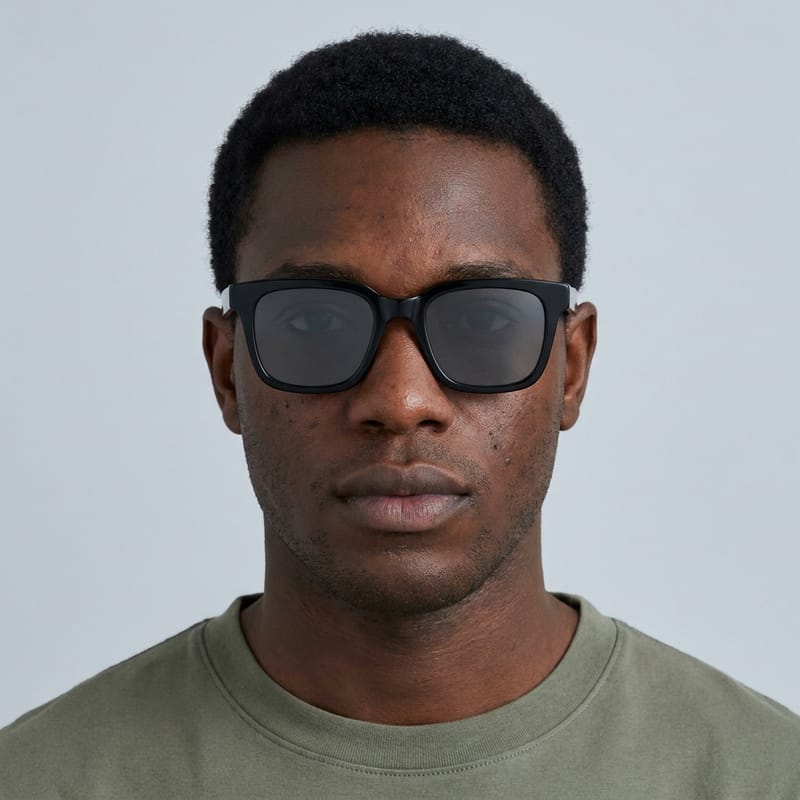
Square sunglasses
Square sunglasses are the round-face rule carried into the sun: a straight brow, firm corners and a deep lens that also covers well. On a long face the depth does a second job and breaks up the length.
Try it on me →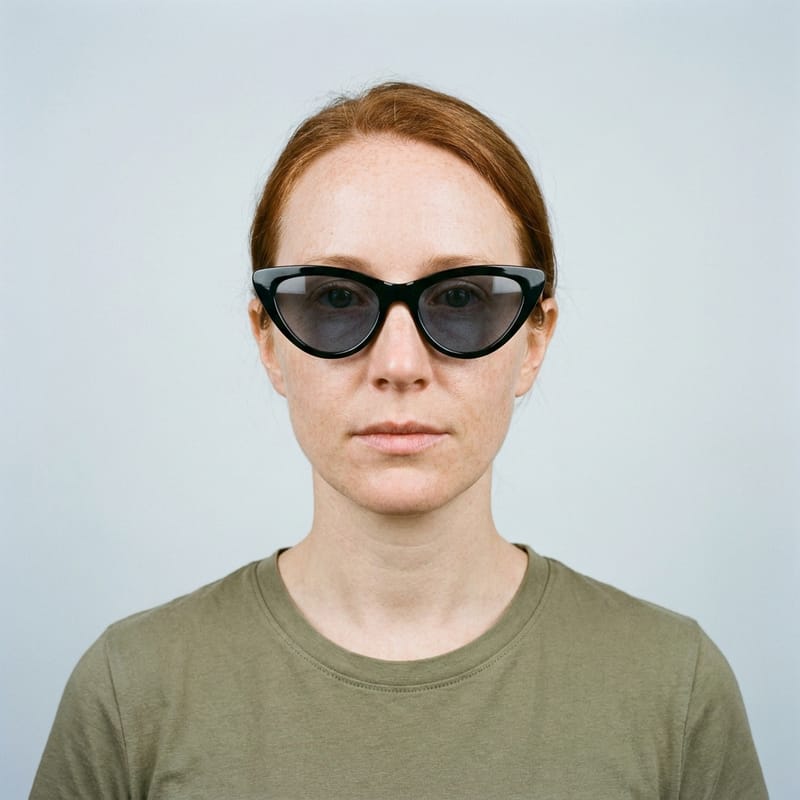
Cat-eye sunglasses
Cat-eye sunglasses show the brow rule still working once the lenses go dark: the lift at the outer corners carries width to the top of the face even when the brows disappear behind the frame.
Try it on me →FAQ
What is the main rule for choosing glasses for a face shape?
Contrast: choose a frame whose lines differ from your face, angular frames for a curved face and rounded frames for an angular one. Then make sure it spans your face from temple to temple and that its top follows your eyebrows.
How do I find my face shape for glasses?
Pull your hair back and compare the width of your forehead, cheekbones and jaw with the length of your face, in a mirror or a photo taken straight on. The widest of the three, and how long the face is against it, points to your shape.
What if my face is a mix of two shapes?
That is common. Start from the feature that stands out most, such as a strong jaw or full cheeks, and use the advice for the shape that feature belongs to.
Are there glasses that suit every face shape?
No frame suits every face, but a slim oval or a rectangle with softly rounded corners works on more faces than most shapes. Sized to your temples, either is a safe start if you are unsure of your shape.
Do face shape rules apply to sunglasses?
Yes, contrast and width work the same way. Sunglasses usually cover the brows, so coverage and width matter more and the brow-line rule matters less.
Are face shape rules different for men and women?
No. The rules follow the face, not who wears it; what tends to differ is the size, color and details such as how much lift a frame has at the outer corners.
Can I wear a frame the rules say to avoid?
Yes, if you get the width and brow line right, because those make a frame look intended. Choose the version that softens the clash, such as rounded corners on a square frame for a square face.
Does face shape matter more than frame size?
No. A frame of the wrong width looks wrong on any face, while a well-sized frame in a less ideal shape usually looks fine, so get the size right first and then choose the shape.